


Rock & Hawk subscribers fall into two camps. Some want to read about birds, and others want to read about me. Accordingly, I’ve created two sections: From the Field for birds, and Onward for me.
If you subscribe to Rock & Hawk, you’re automatically subscribed to From the Field, because I’d guess more of you are here for birds. Onward is opt-in. This is a sample of what will be there.
What Does It Mean to Let Something Define You?
I never wanted my disability to define me. As I approach the fourth anniversary of my accident, my perspective has shifted.
There’s never a moment when my disability doesn’t demand accommodation. It changes how I move through the world, and it isn’t going away.

Recovery Is Lifelong
I’m no longer wed to the idea of a “full recovery.” Improvements are welcome, but I’m not losing sleep over getting back to how I was.
Years after a TBI, improvements tend to be small and undramatic. They’re still improvements. It’s an odd privilege: I’m able to “get better” for the rest of my life. Rather than one big recovery, I get a thousand tiny ones—and I can keep working toward more. That said, if I can always get better, I’ll never be better.

“Lifelong” Doesn’t Mean “Full”
The Brain Injury Association of America explains that most see brain injury “as a one-time event with effects that become stable.” Instead, it’s the start of a “process of recurring or persistent effects that continue to change.”
The phrase “full recovery” implies completeness and finality: an ending. In reality, one in 60 Americans lives with permanent disability after brain injury. I’m one of them.1
Looking Back, Looking Forward, Looking at Memory
The last memory I have before my TBI is vague: a gas station on my way to an Everglades tour.


I’d spent the preceding days with Wood Storks, a Loggerhead Shrike, a Roseate Spoonbill, and many others.


Those birds were at Loxahatchee, Wakodahatchee Wetlands, and Green Cay Wetlands.


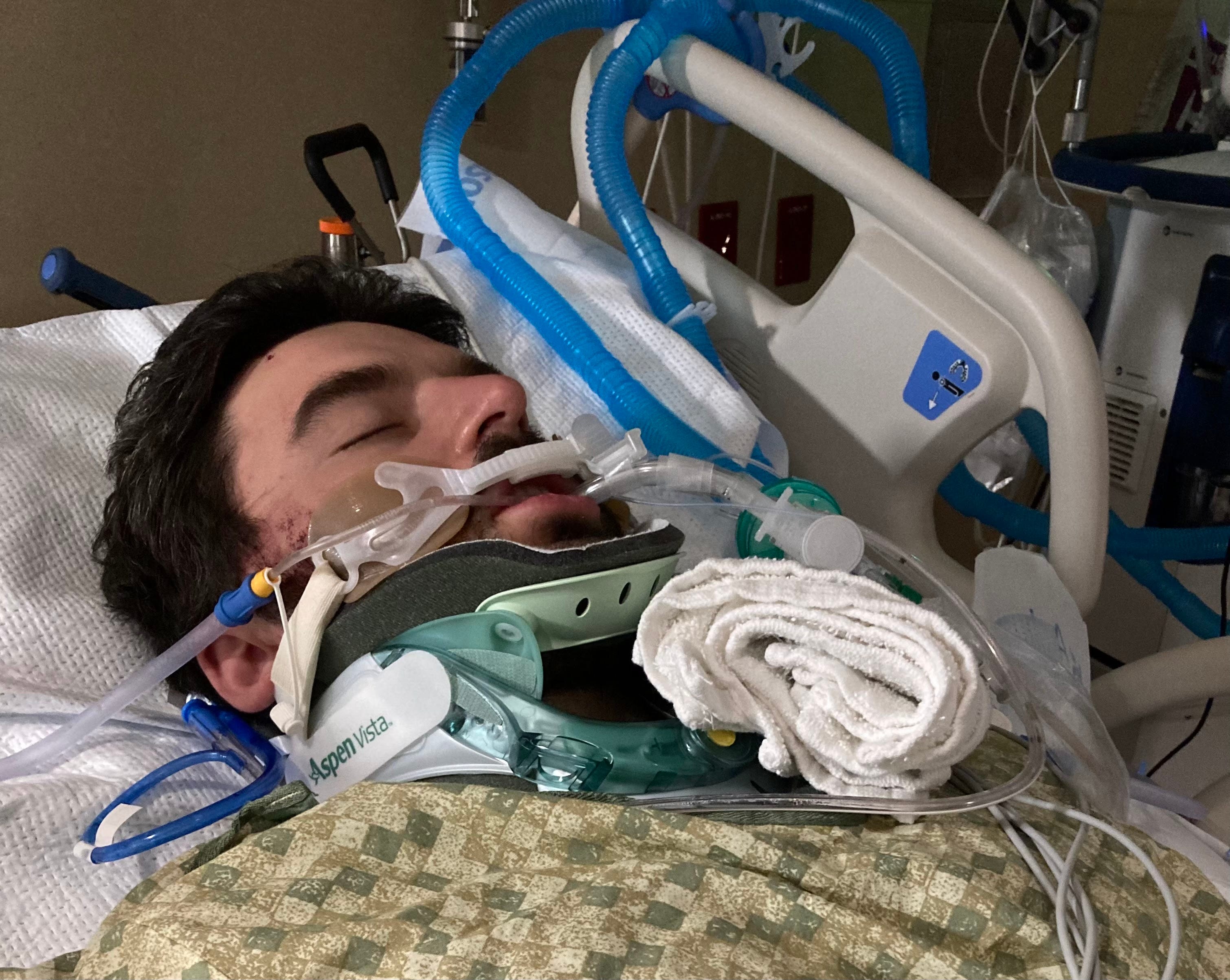
Then, my life split in two: before and after. An 18-wheeler hit my rental sedan. I suffered a diffuse axonal traumatic brain injury and have no memory of it.
For a long time, I figured no memory meant no trauma. If I couldn’t remember it, it couldn’t hurt me—but my life still has a hinge. Everything was fine, then it wasn’t. The accident rewired me. When things are good, my brain doesn’t let me enjoy them. It catastrophizes to an absurd degree.

My first memory after the accident comes a month later: Spaulding Rehab in Boston. A nurse was telling me not to rip my trach tube out again—I’d already done that once. You don’t want to rip out a tracheostomy. After brain injury, agitation can become baseline. Couple that with stubbornness, and I can imagine my not-yet-online brain: Get this fucking thing out of my neck.
Everything between the gas station and Spaulding is blank. I know it happened—a month at a hospital in Miami, the med-flight to Boston, the start of another month at Spaulding. It all must have happened, but I can’t tell you about it.
I remember my life beforehand, but the version of me in those memories is a different person. Disability is part of me now. It always will be.

Acceptance vs. Complacency, and Dostoevsky
Dostoevsky writes in Notes from a Dead House:
“Man is a creature who gets used to everything, and that, I think, is the best definition of him.”
He invokes the same sentiment in Crime and Punishment, but adds, “the scoundrel!”
Dostoevsky’s bitterness used to pervade my mind. I loved Notes from Underground and identified with the Underground Man—not a protagonist you want to identify with. Sometimes that bitterness rears its head as I get more used to my disability.
Pah!2 Only a scoundrel gets used to chronic disability. And only a scoundrel accepts it!
I conflated acceptance with complacency, but it’s possible to accept something without becoming complacent. My disability is an asterisk—not always negative, but always there to work around.

Gratitude
Another relevant Dostoevsky line comes in Notes from Underground.
“I even think the best definition of man is: a being that goes on two legs and is ungrateful.”
I love Fyodor, but I have to push back. My TBI serves up heaping plates of reasons to be ungrateful, but I’m grateful. I’m alive. I’m moving forward. I have a great family, friends, and a partner who loves me.
Things could be better. They could also be much worse.

Daily Life, Disabled
Something else I’m grateful for is being able to walk up a flight of stairs. In the hospital, they weren’t sure I’d ever be able. During months of PT, I busted ass to make sure I would be—but it’s definitely different. There’s a staircase I take regularly, and I always meet its first step with:
God, I hope nobody’s behind me. Why can’t I be more fluid?
I’d never think that but for my disability.

It Defines Me
The longer I live with my disability, the more I write about it. Every word gives it purchase. It defines my life. By proxy, it defines me.
My charge is to ensure it defines me in a meaningful way. My aim is to help others in the disabled community feel understood and less alone, and to help those outside it understand what living with disability is like.

Embracing What Remains, Grieving What Doesn’t
For nearly 29 years, I built an identity. Then it got turned on its head. I’m different, but I’m still me. When you get to know me, you might not think:
That guy is disabled.
Instead, you might think:
That guy loves to talk about ducks. How many iced coffees did he have?

I Don’t Look Disabled
No wheelchair, no cane, no prosthetic limbs. Mine is an invisible disability.
I spend a lot of time at the gym. You might think that’s out of ego, but it’s not. It’s comforting when the effort I put into something is directly commensurate with the results. Plus, it’s good for my brain.
Neuroplasticity occurs in response to new experiences. To a meathead, “new experience” means “more weight.”3 Some research suggests that weightlifting increases Brain-Derived Neurotrophic Factor, BDNF—a protein that strengthens connections between brain cells and can help generate new ones.
My love of lifting is also fueled by the fact that I couldn’t do it for a long time. It’s a reminder of how far I’ve come. In the early months after my accident, a three-pound dumbbell became ego-shatteringly heavy. All I could squat was a 10-pound kettlebell. I’m stronger now, but my body isn’t fully back—my right side is noticeably weaker. When I squat, it’s clear which leg will fail first. The strength is there; the brain’s axonal connection to the muscle is not.

My Eyepatch
Though I might not “look disabled,” I wear my eyepatch all the time. I’ve needed to wear one ever since my accident,4 but I was embarrassed. I didn’t want to draw attention to myself. If I could get by without it, I tried.
Just until surgery. One surgery. Nope. Two. Nope. Three? Nope. I disregarded my diplopia and continued without a patch. An eyepatch slows binocular vision recovery, and I didn’t want that—but after three surgeries and so much time? There’s no sense worrying about slowing something that just isn’t happening.

Larissa’s friends have an optometry clinic.5 They’ve graciously fit me into their schedule a couple times. One told me, “You have double vision because both eyes see well.” He asked for my glasses and popped a lens out to help tide me over until a better solution. It helped, but an eyepatch is better.
Eventually, I’ll get an occlusion contact lens. The eyepatch went from just until surgery to just until the occlusion lens. I’m done with just until. There’s no sense telling myself this is temporary when it’s not.

I didn’t embrace my eyepatch until months into law school. I’d be meeting new people and didn’t want to be the eyepatch guy. I still needed it for exams. With my accommodations, I take exams in a separate room. Nobody saw when I wore it, so I wasn’t embarrassed. In early November, I decided to keep it on.
Early November was a poor time to become the eyepatch guy. “Halloween is over!” I try not to let comments like that upset me, especially from people who’ve only known me briefly, without my eyepatch, and who don’t know about my TBI. I give people the benefit of the doubt.

There’ve been comments that didn’t warrant that benefit. I’ll spare you the specifics, but my default was to get very angry. I didn’t need to. Anger can be a positive emotion when used productively, but it’s more often an unproductive misdirection of energy.
A comment or joke might not warrant the benefit of the doubt, but still doesn’t warrant anger. If I couldn’t move past every time someone didn’t understand my disability—or that I even have one—I’d be stuck in place.
Most people just ask: “Are you okay?” “What happened?” If they know about my initial eyepatch resistance: “Do you wear that all the time now?”
Law school gives me a concrete and understandable explanation. “My eyepatch makes reading easier.” It also signals that I’m not letting my disability hold me back. I won’t be valedictorian, and “Big Law” isn’t my goal, but I’m still doing this.

It was unwise to read hundreds of pages of legal doctrine while constantly choosing between images—a self-imposed distraction an eyepatch could’ve fixed. One class had regular assessments. On the first: 40%. I’d studied without an eyepatch. For the second, I studied with it: 90%. It wasn’t just the patch, but I’m sure it helped.
I used to wear my eyepatch every day for a manual labor job in 2023—working in the sun with power equipment and an eyepatch. I had an eyepatch tan line. I texted a friend who supervised me at that job. “You’ll be happy to know the eyepatch is back full time.” He replied: “Hell yes. That’s a legendary part of you.”


It is part of me. I dropped one on the sidewalk. Soon after, my phone rang. “Did you drop your eyepatch?”
Yep, it was me. I’m the eyepatch guy.

Sisyphus
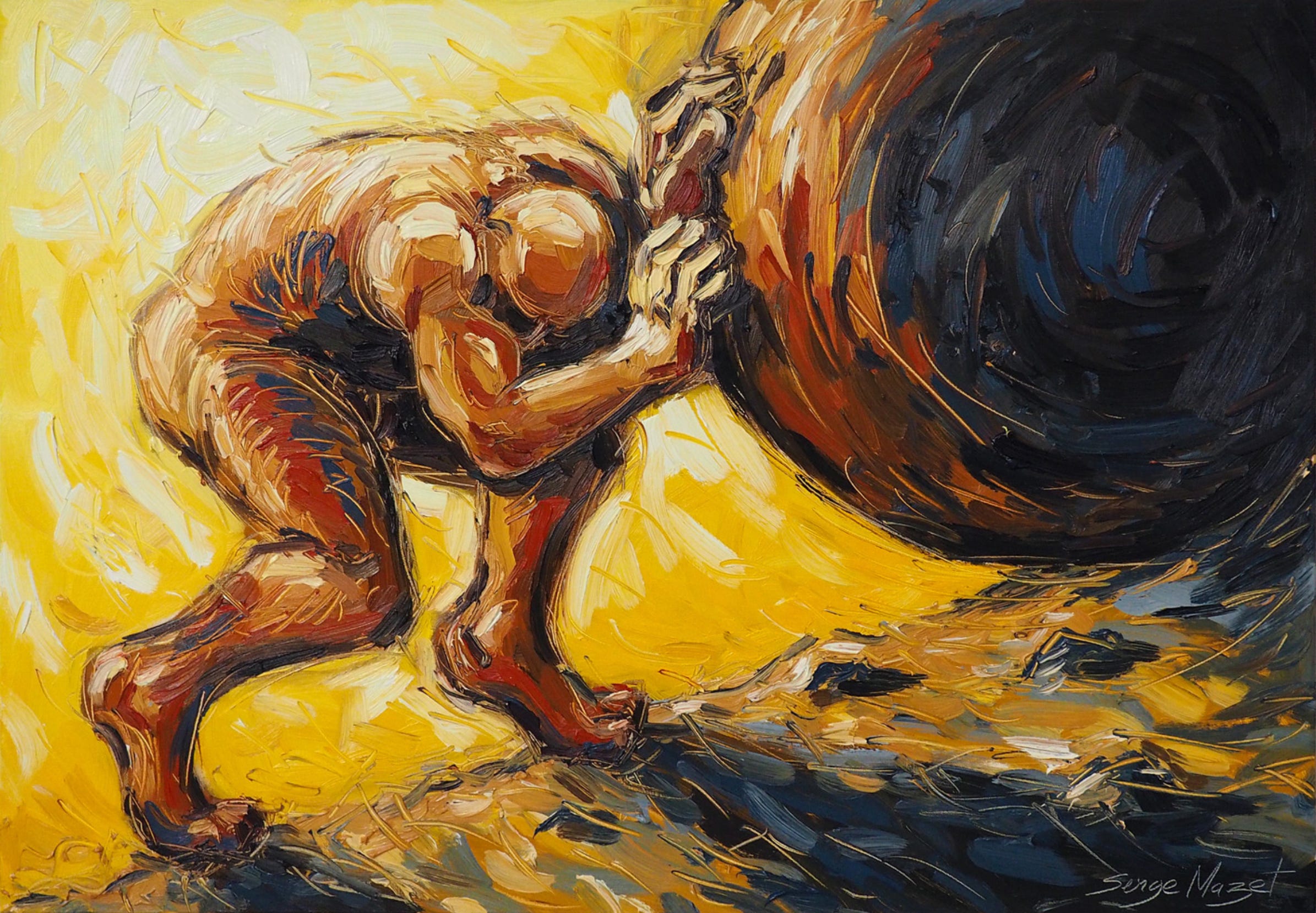
Sisyphus rolls his boulder uphill for eternity. When he nears the top, it rolls back down. He starts over, nears the top, and the stone rolls back down again. Repeat ad infinitum. Pure futility, a bitch of a punishment.
Sisyphus has his stone; a disabled person has their disability. It’s not a perfect comparison. Calling life with a disability “Sisyphean” feels cheap and defeatist. Calling my life with disability “Sisyphean” implies victimhood. I am not a victim. I’m a survivor—I came out the other side.

Was Sisyphus a victim? Victim of the gods’ punishment, yes. If you told Sisyphus he was a victim, I imagine he’d dismiss you and get back to his stone.
Camus’ conclusion in The Myth of Sisyphus is memorable and affecting. “One always finds one’s burden again.” Sisyphus illustrates the absurdity of human life. “Each atom of [Sisyphus’] stone, each mineral flake of that night-filled mountain, in itself, forms a world”—a world of struggle. Struggle “is enough to fill a man’s heart,” Camus goes on. “One must imagine Sisyphus happy.”

We too must be happy. I push my stone each day. It will roll. I’ll push. I can either see that as unfair misery or find joy in pushing. I choose joy.
It’s better to learn to live with and love your stone. I know and accept mine, and I know and accept the version of myself I have to be with it. There’s no denying its hefty indifference, but I’ve learned to keep it from flattening me.

Identity & Acceptance
For a long time, I was in denial about my disability. I minimized it—told myself it wasn’t that bad. Years after the accident, a neurologist still described it as severe. My denial drowned that out.
Now I accept it. I own it. “I’m disabled” isn’t something I hide. Moving forward leaves no choice.

I’m a writer, a birder, a bookish meathead who survived a diffuse axonal injury. I’m disabled. I wear a cool eyepatch. Depending on the shirt, you can see my trach scar.
It’s not so bad to let something define you on your own terms.

My DAI was primarily to my left frontal lobe. Injury to the frontal lobes can lead to personality shifts, physical weakness, and speech issues. The left frontal lobe is home to Broca’s area, “associated with speech production and articulation.”
“Pah!” is a classic Dostoevskyism.
More weight. More creatine.
Disclaimer: I’m not a doctor; I’m a nerdy meathead with a TBI who takes creatine and has internet access. This is my reading of the publicly available research, not medical advice.
More Creatine:
I’ve taken creatine for a decade—five grams daily. Creatine helps the brain. More is not always better, but for the brain, ten to twenty might beat five. I wondered if creatine might help with TBI recovery.
Creatine has “potential as a neuroprotective agent and a treatment for brain-injury complications.” It offers “an obvious benefit to patients suffering from TBI” and shows “superior efficacy as a neuroprotective agent in battling…oxidative stress and [supporting] cognitive function post–brain injury.”
Taking creatine might increase brain creatine, improving cognition, “particularly under stressful…conditions.” One study gave human participants creatine before depriving them of sleep for 36 hours. They did better on an executive-functioning test than people who’d slept but hadn’t taken creatine. “Preliminary studies…suggest that creatine supplementation may be useful in the treatment of the secondary and long-term symptoms of TBI.” There is “evidence of the potentially positive therapeutic effects of creatine on brain function and behavior after brain injury,” but more research is needed.
Get stronger while reaping the cognitive benefits? I volunteer as guinea pig. I’ll always live with my TBI; I’ll always take creatine.
More weight:
A 2024 article from the International Journal of Sports Medicine covers experiments where subjects did bench press, leg press, and lat pull-downs at 60% or 80% of their one-rep max (1RM) to see lifting’s impact on Brain-Derived Neurotrophic Factor (BDNF). Lifting at 60% led to “no significant changes…[in] BDNF concentration.” 80% increased BDNF “from 461 to 1730 pg/ml (p=0.035).” More weight “can significantly enhance circulating levels of BDNF.”
To a meathead with a TBI, that’s candy. Go heavier—for your brain. And that’s just leg press, bench, and lat pull-downs. Imagine how good a heavy squat is. Make Tom Platz proud.
After TBI, if vision heals on its own, it typically takes about a year—not four. Prism lenses offer a potential solution, or there’s surgery.
I tried prism lenses. I tried surgeries. Neither worked.
Prisms work when the difference between the eyes is small and consistent. If double vision is inconsistent, or across more than one axis, prisms can be rendered moot.
The difference between my eyes is not small enough, and my double vision is inconsistent. At two different appointments with the same doctor, I did the same eye test with vastly different results.
Surgery also doesn’t always work. After TBI, the brain can lose the ability to fuse images even when the eyes are surgically brought closer.
An eyepatch is functional finality.
Lumen Eye Care. If you’re in southern New Hampshire and need your eyes looked at, give them a call.
I’ve been to no shortage of eye doctors. The original neuro-ophthalmologist I saw was the first doctor I looked forward to seeing. My eye surgeon was the second. My sample size for skilled eye doctors is considerable. It’s not every day you find eye doctors with the empathy, professionalism, and forward-thinking expertise of Drs. Daldine and Samuel.
An occlusion lens in lieu of an eyepatch hadn’t been presented as an option until they suggested it. Going without a prescription in one eye also hadn’t been. Drs. Daldine and Samuel explained, straightforwardly and accessibly, why it would likely help.
When I went to Lumen to order an occlusion lens, I got a lesson on putting in and taking out contacts. I couldn’t do it. Neither uncommon nor unfixable. Dr. Daldine shared his own story of initial difficulty, gave me instructions to calm my reflexive eyelids, and told me to make another appointment when I felt more confident.
I'm glad you're writing more about your disability. It helps us all understand better. So amazing what you've accomplished. Loved the way you laid this all out - and as a bonus, always, the bird pics.
I can't remember if I've shared before, but I have several people close to me who have various levels of TBIs and I'm always grateful when you write about it. Forgive the unsolicited readings, but I'm curious if you ever venture into critical disability studies/crip theory literature? I highly recommend Eli Clare (any of his books) and Leah Lakshmi Piepzna-Samarasinha (also any of their books). Sending you good wishes (& gainz!!!) for the new year!